Snow Mountain Village Art Print, traditional Chinese ink wash, winter landscape decor, serene home art, gift for sumi-e lovers
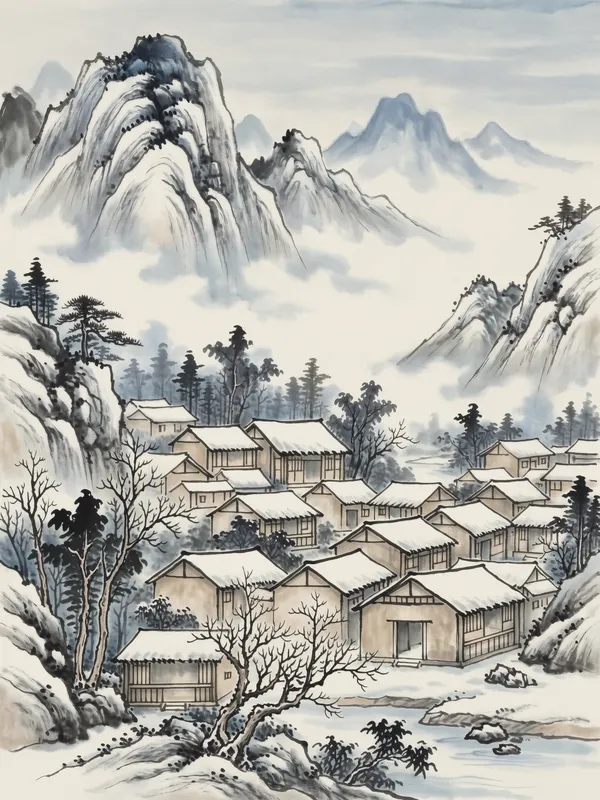
Snow Mountain Village 雪村 presents a serene winter landscape in traditional Chinese ink wash, with a village nestled beneath snow-covered mountains. Delicate layered brushwork, misty perspective, soft black gradients, and a touch of indigo meet the textured edge-to-edge grain of Enhanced Matte Paper (189 g/m²), making this art print a calm accent or thoughtful gift for lovers of sumi-e.
At first glance, the eye meets a quiet arrangement of dark peaks, pale snowfields, and a small village gathered low in the valley. The mountains rise in overlapping planes rather than a single solid ridge, giving the scene depth while keeping its edges soft. Fine, restrained lines describe rooflines, slopes, and distant forms; wider washes gather beneath them in smoky layers of charcoal, grey, and softened black. A restrained touch of indigo enters the otherwise monochrome palette, cooling the snow and drawing the eye through the mist. The village is small against the surrounding mountains, yet its clustered shapes give the landscape a point of human scale. The surface carries a visible grain from the enhanced matte paper, allowing the ink-like marks and gentle tonal changes to retain a tactile, almost brushed presence from edge to edge. Nothing is crowded: open areas of light sit beside denser passages of ink, creating a composition that feels measured and spacious.
The image belongs to the traditional Chinese ink-wash landscape tradition, where a scene is shaped through the relationship between brush movement, diluted ink, and unpainted space. One concrete marker of that tradition is the graduated wash: a dark stroke can soften into a translucent grey, then dissolve almost completely into the surrounding white. Here, that technique appears in the layered mountain faces, the drifting bands of mist, and the shadowed ground beneath the village. Rather than describing every tree, stone, or building with equal detail, the work lets a few economical lines suggest the wider setting. This approach gives the print a contemplative character while preserving the handmade rhythm of the original style. Viewers drawn to sumi-e may recognize a related appreciation for controlled brushwork, tonal restraint, and the expressive space around a mark. It suits a room where art can be noticed gradually, with details emerging as the eye moves from the indigo distance to the village roofs and back into the pale mountain air.
On a wall, Snow Mountain Village works well where there is room around it for the composition to breathe: above a reading chair, beside a low bookcase, in a bedroom, or along a quiet hallway. Its softened black and grey tones can sit naturally with warm white, stone, pale oak, charcoal, or muted blue furnishings, while the small indigo accent can echo a cushion, vase, or painted cabinet nearby. Daylight from a nearby window will reveal the faint transitions between ink washes and make the snowfields appear lighter; evening light with a warm cast will bring forward the darker village and mountain contours. Avoid placing it where a busy pattern competes with the misty spacing. In a calm interior, the print offers a view into a winter valley without introducing bright colour or visual noise. It can serve as a considered gift for someone who collects Chinese ink-wash imagery, studies sumi-e, or prefers landscapes built from line, atmosphere, and silence.
“A hushed ink-wash village beneath snowy peaks, soft monochrome palette turning any wall into a pocket of stillness.”
- SubjectSnow-blanketed alpine village rendered in traditional ink-wash style with delicate brushwork.
- Palette & lightSoft greys, muted whites and pale blues convey cold air and gentle overcast light.
- CompositionCentral village cluster framed by layered mountain ridges receding into atmospheric haze.
- Where it fitsA serene bedroom retreat, quiet reading corner, or living room craving calm.
| Material | Enhanced Matte Paper (189 g/m²) |
| Digital printing | |
| Care | Frame or mount out of direct sunlight; wipe gently with a dry, soft cloth. |
| Shipping | Made to order — ships in 2–5 business days |