Dichotomy of Control Art Print, Stoic philosophy decor, dramatic marble bust, study and library wall art, philosophy gift
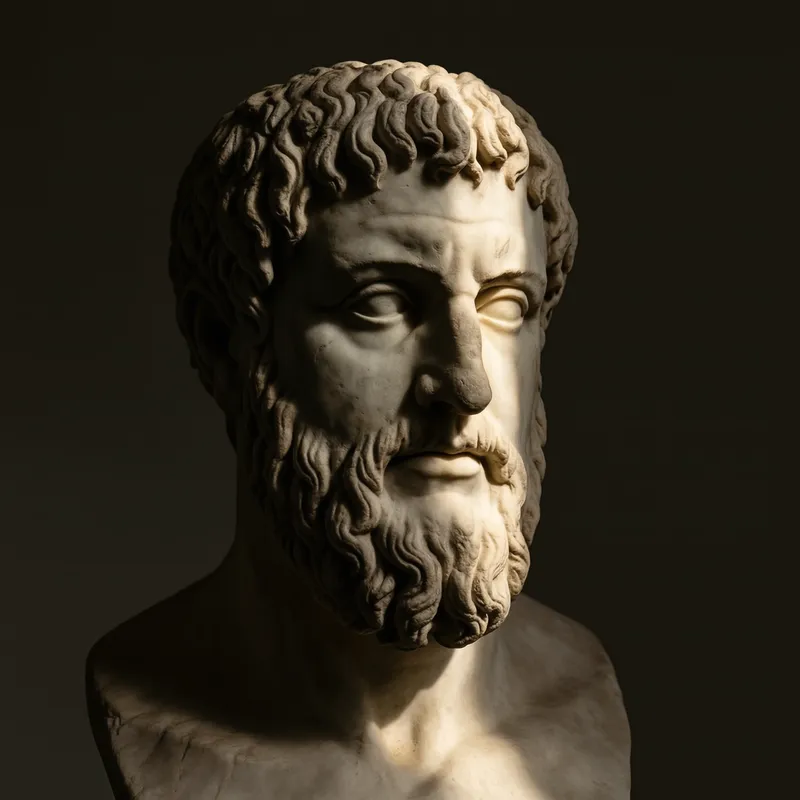
The “Dichotomy of Control” art print presents a marble bust of a Stoic philosopher in dramatic light, revealing its sculptural texture and fine details. Printed on enhanced matte paper (189 g/m²), this refined philosophical artwork suits a study, library, or modern living space, and makes a thoughtful gift for philosophy enthusiasts and art lovers.
The eye meets a pale marble face emerging from a field of deep shadow. The composition is built around the bust, with its head and shoulders occupying the visual centre while the surrounding darkness gives the form room to breathe. Light travels across the forehead, cheek, nose, and mouth, then falls away into charcoal and black, creating a measured contrast between illuminated stone and the nearly empty background. The palette stays restrained: ivory, cool grey, slate, and near-black, with no bright colour to interrupt the mood. Fine contours describe the brow, lips, curls, and carved planes of the face, while softer tonal transitions suggest the worn, granular character of marble. The result has the clarity of a study object rather than a busy decorative scene. From across a room, the strong silhouette reads immediately; closer in, the small changes in light and shadow invite a slower look. Its visual language suits a space where books, writing, and quiet concentration already have a place.
The image draws on the Greco-Roman tradition of philosophical portrait sculpture, interpreted through a clean, contemporary arrangement of light and negative space. Its clearest classical marker is the bust format: a head and upper torso presented as an object for contemplation, rather than a full figure placed in an active scene. Marble also carries a direct connection to the ancient Mediterranean world, where carved portraits and idealised likenesses were used to give thought, character, and public identity a physical form. Here, the emphasis is less on identifying a named individual than on the expression of a disciplined mind. The title points toward the Stoic distinction between what can be directed and what must be accepted, and the restrained composition reinforces that idea without turning it into an illustrated lesson. There are no surrounding symbols, crowded motifs, or decorative flourishes competing with the face. The classical reference makes the print sit comfortably alongside busts, maps, leather-bound volumes, and architectural drawings, while the simplified presentation keeps it relevant in a modern interior.
Place it above a writing desk, beside a reading chair, or on the wall behind a low bookcase in a study or library. It also works in a living room with quiet materials: walnut shelving, blackened metal, oak, linen, stone, or warm white plaster. The image wants directional light rather than an evenly bright wall. A reading lamp, picture light, or window from one side will echo the print’s contrast, allowing the raised marble details to catch a gentle glow while the darker areas remain grounded. Against a white, cream, dove-grey, olive, or muted blue wall, the black background forms a clear visual anchor; against charcoal or deep green, the pale face becomes more closely integrated with the room. Hang it where the viewer can approach it, since the smaller carved details reward distance and proximity in different ways. As a gift, it suits someone drawn to Stoic philosophy, classical form, quiet interiors, or art that gives a room a reflective focal point.
“A classical marble bust anchors a room with quiet gravitas, offering a meditative nod to Stoic wisdom for thoughtful spaces.”
- SubjectMarble bust of a Stoic philosopher rendered with dramatic chiaroscuro lighting, evoking ancient gravitas and intellectual depth.
- Palette & lightMuted stone tones and deep shadow contrast, with warm highlights tracing sculpted features against a dark backdrop.
- CompositionCentered, dignified portrait orientation that draws the eye to the contemplative gaze and classical profile.
- Where it fitsA reading nook, home library, or office where quiet reflection and intellectual pursuits take center stage.
| Style | Photographic |
| Subject | Marble Stoic philosopher bust |
| Colors | black |
| Orientation | Square |
| Suited to | reading nook, office |
| Material | Enhanced Matte Paper (189 g/m²) |
| Digital printing | |
| Care | Frame or mount out of direct sunlight; wipe gently with a dry, soft cloth. |
| Shipping | Made to order — ships in 2–5 business days |