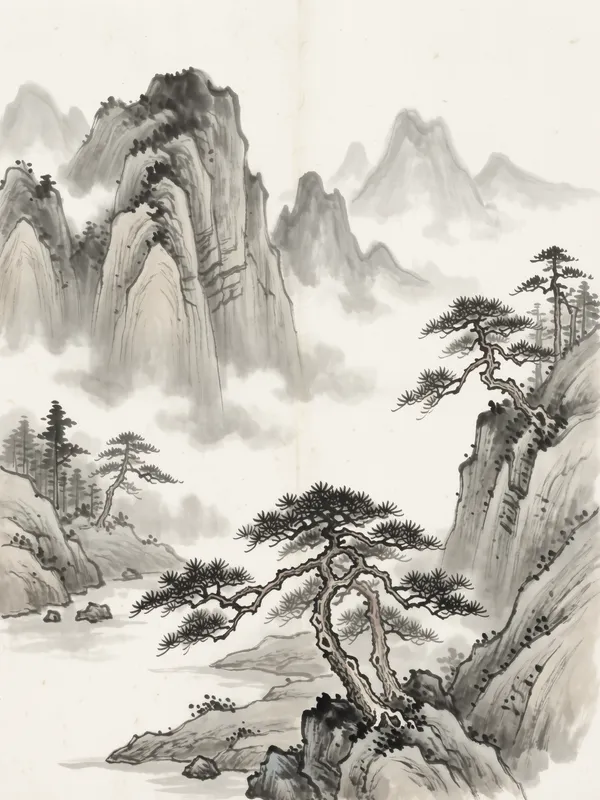
Misty Mountain with Ancient Pine Art Print, traditional Chinese ink wash, sumi-e wall art, meditation room decor, peaceful gift
An ancient pine rises through misty mountain forms in this traditional Chinese ink wash painting, rendered in a serene sumi-e style with delicate brushwork and soft black gradients. Printed edge to edge on Enhanced Matte Paper (189 g/m²), the full-bleed rice paper texture preserves its quiet atmospheric depth, making this art print a peaceful accent for a meditation space or thoughtful gift.
The eye meets a tall pine first, its dark trunk rising from the lower centre and bending slightly as it reaches into the open air. Layered mountain shapes gather behind it, appearing and disappearing through pale veils of mist. The palette stays close to charcoal, smoke grey, and softened black, with a small range of diluted ink tones creating distance without hard outlines. Fine branches extend like narrow brush strokes, while the needles form quiet, feathery clusters against the empty space. Some edges are clearly drawn; others dissolve into washes, giving the scene a measured rhythm between definition and silence. The composition leaves room around the tree, so the pine feels rooted yet not enclosed by the surrounding peaks. Viewed up close, the delicate marks and gradual black-to-grey transitions remain visible; from across the room, they settle into a calm mountain silhouette. The edge-to-edge image carries a subtle rice-paper-like texture across its matte surface, keeping the restrained character of the ink visible rather than turning the landscape into a flat graphic.
This work belongs to the shanshui, or “mountain-and-water,” tradition of Chinese ink landscape painting, where a landscape can suggest atmosphere, balance, and contemplation as much as a particular place. Its concrete marker is the controlled use of ink dilution: concentrated black gives the pine its weight and age, while lighter washes recede into the mountain forms and mist. That approach lets the brush communicate both structure and air. The style also shares the quiet economy associated with sumi-e, using a limited palette and purposeful strokes instead of filling every section with colour. There are no bright pigments competing with the tree or the peaks; the visual variety comes from pressure, wetness, spacing, and the movement of the brush. The ancient pine acts as the steady vertical element, while the surrounding forms are built from softer horizontal and diagonal passages. Together, these choices make the image feel less like a literal map of a mountain range and more like an inward landscape suited to slow looking.
On a wall, the print works well where there is space for its vertical tree and surrounding mist to breathe: above a low console, beside a reading chair, or on a quiet wall in a meditation room. Natural wood, bamboo, linen, warm white plaster, and pale stone would sit comfortably beside its charcoal tones. In a room with darker furniture, the soft grey washes can provide a gentle transition rather than a sharp contrast. Place it near morning light or filtered daylight so the fine branches, translucent mountain layers, and subtle surface texture remain legible. It also suits a shaded corner with a small lamp casting warm light from the side, which can bring out the difference between dense black ink and nearly white mist without changing the restrained palette. Keep the surrounding wall relatively uncluttered; the open areas are part of the composition. As a gift, it carries a quiet association with stillness and reflection, making it suitable for a study, bedroom, meditation space, or any room intended for pause.
“Soft sumi-e ink gradients dissolve mountain and pine into a meditative focal point, bringing quiet depth to any wall.”
- SubjectMisty mountain rising behind a lone ancient pine, rendered in classical sumi-e ink wash
- Palette & lightRestrained monochrome of layered blacks and silvery grays on warm enhanced matte paper
- CompositionEdge-to-edge atmospheric perspective with negative mist softening every distant contour
- Where it fitsReading corner, home office, or living room seeking a calm, contemplative focal point
| Material | Enhanced Matte Paper (189 g/m²) |
| Digital printing | |
| Care | Frame or mount out of direct sunlight; wipe gently with a dry, soft cloth. |
| Shipping | Made to order — ships in 2–5 business days |