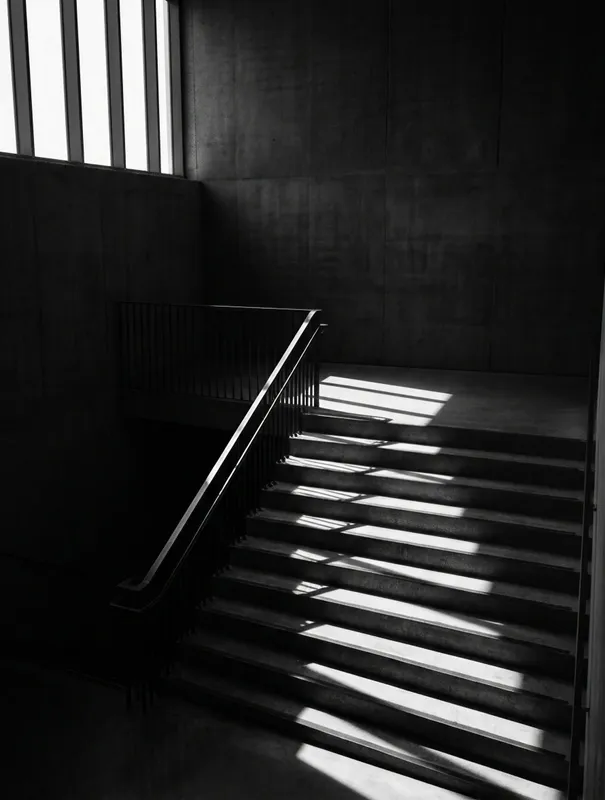
Staircase Light Stripes Art Print, black and white photography, minimalist wall art, hallway decor, housewarming gift
Staircase Light Stripes presents a stark black and white fine art photograph of an empty staircase, where a sharp beam creates dramatic bands of shadow and light across the steps. Printed on Enhanced Matte Paper (189 g/m²), its moody monochrome contrast and generous negative space bring quiet architectural character to a hallway, office, or thoughtful housewarming gift.
The eye meets a spare arrangement of steps, rails, and angular edges set against deep black and clean white. A concentrated shaft of light crosses the staircase, breaking the ascending forms into alternating bands that move diagonally through the frame. The steps appear less like a route to somewhere than a sequence of measured planes, with each bright strip separated by a firm block of shadow. There are no figures, objects, or decorative details to interrupt the structure. Instead, the photograph relies on line, spacing, and contrast: thin edges guide the gaze upward, while the broad dark areas create pauses between the illuminated surfaces. The monochrome palette keeps the image focused on form and atmosphere, and the generous areas of darkness give the composition room to breathe. Its quiet tension comes from the meeting of practical architecture and carefully shaped light, making the staircase feel both familiar and slightly removed from everyday use.
This approach belongs to the modernist tradition of architectural photography, in which ordinary built spaces are treated as studies in geometry, proportion, and light. A concrete marker is the reduction of the subject to rectangular planes, repeated lines, and a limited black-and-white palette rather than descriptive detail. The staircase is not presented as part of a larger interior or identified by a particular location; it is distilled into a pattern of steps, shadows, and illuminated surfaces. That restraint connects the image with the geometric discipline often associated with Bauhaus-era design, where function and structure could become the visual subject themselves. The photograph does not depend on ornament or colour to hold attention. Its character comes from the precise relationship between the diagonal stair line, the horizontal treads, and the sharp divisions made by the light. For a room furnished with wood, concrete, black metal, linen, or pale plaster, the image can act as a measured architectural note rather than a competing decorative element.
Give it a wall where the contrast can remain legible and the surrounding space can stay relatively calm. In a hallway, it can extend the sense of movement created by the corridor, echoing door frames, banisters, and floorboards with its repeated lines. Above a console, bench, or narrow cabinet, the dark-and-light structure provides definition without introducing another colour into the room. In an office or reading corner, it suits a setting of simple furniture and indirect illumination, where the photograph’s quiet mood can sit alongside books, timber, or brushed metal. Natural daylight will make the pale areas shift subtly from cool to warm as the day changes, while a nearby wall light can draw out the separation between the lit steps and the surrounding shadows. A white wall will emphasise the black shapes; a charcoal, stone, or muted grey wall will make the bright bands feel more integrated. Its restrained subject and neutral palette also make it a considered housewarming gift for someone drawn to architectural detail, monochrome interiors, and spaces with room to pause.
“Architectural light stripes cast across a minimalist staircase, turning geometry into quiet drama for modern interiors.”
- SubjectDramatic light bands falling across a stark, minimalist staircase in monochrome.
- Palette & lightPure black and white with high-contrast light stripes and deep shadow.
- CompositionStrong diagonal geometry leads the eye upward through layered architectural lines.
- Where it fitsModern living room, home office, or as part of a curated gallery wall.
| Style | Photographic |
| Subject | Empty staircase with light stripes |
| Colors | black, charcoal |
| Orientation | Portrait |
| Suited to | living room, gallery wall, office |
| Material | Enhanced Matte Paper (189 g/m²) |
| Digital printing | |
| Care | Frame or mount out of direct sunlight; wipe gently with a dry, soft cloth. |
| Shipping | Made to order — ships in 2–5 business days |