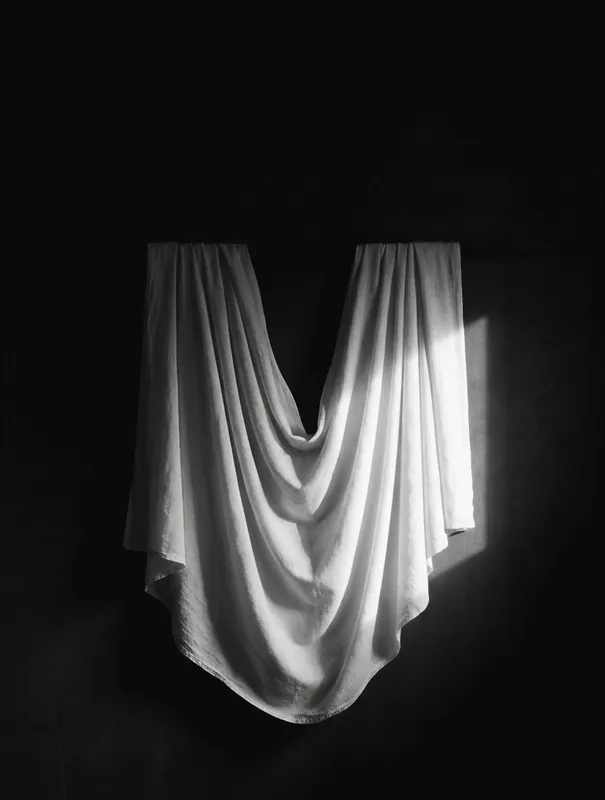
Folded White Drapery Art Print, minimalist black and white photography, moody living room decor, gift for photography lovers
Softly folded white drapery emerges from deep shadow in this minimalist black and white fine art photograph, where a narrow beam of light shapes the generous negative space. Printed on Enhanced Matte Paper (189 g/m²), the photorealistic monochrome Art Print brings quiet drama to a bedroom, living room, or home office, and makes a thoughtful gift for photography lovers.
Drapery begins with an ordinary material: cloth arranged to divide, soften, cover, or frame a space. In visual culture, folded fabric has often been used to study the language of light and form, from the hanging garments and table coverings of painted interiors to the curtains and sheets found in domestic photography. White cloth is especially suited to this kind of attention. It carries no printed pattern to lead the eye, so its surface is described by creases, edges, overlapping planes, and the grey tones created where one fold turns into another. A curtain can suggest privacy, shelter, or a boundary between the room and what lies beyond it, while a loose fold remains an entirely physical thing: cotton or linen gathered, pressed, and allowed to fall. This photograph draws on that familiar subject without turning it into a scene or narrative.
Here, the drapery appears in white against a field of near-black shadow. A slim beam of light enters the composition and catches selected ridges, leaving the valleys between them in charcoal and deep grey. The folds form soft vertical and diagonal shapes rather than a repeated pattern, with broad areas of empty darkness giving the fabric room to breathe. Because the image is monochrome, the eye moves through tonal changes instead of colour contrasts: white highlights along a raised edge, silver-grey planes across the middle of a fold, and dense black around the cloth. The photograph keeps its focus close to the material, making the texture feel present without introducing a visible room, figure, or object to compete with it. Its quiet drama comes from the measured relationship between light and shadow, softness and structure, concealment and reveal. In a bedroom, living room, or home office, it can sit above a pale wood console, beside a black metal lamp, or against a wall where its restrained palette can work with both warm and cool furnishings.
This print will appeal to people who notice the shape of light on everyday surfaces: photographers, designers, and anyone drawn to black-and-white images with space around their subject. It may speak to someone who prefers a room with a limited palette of white, black, stone, charcoal, and natural wood, or to a collector building a quiet grouping of photographic works rather than a brightly coloured gallery wall. The image is also suited to a person who recognises the emotional quality of an unoccupied interior—the pause before a curtain is moved, the stillness of fabric after the light has changed, the sense of a private corner held just outside view. Hung on its own, the photograph gives a wall a simple arrangement of folds and shadow. Placed with other B&W Minimalist prints, it can provide a soft, organic counterpoint to images built from architecture, geometry, or hard-edged forms. For a photography lover, it offers a subject that is familiar in substance yet open to close looking, with each fold carrying a different balance of light, weight, and space.
“Folded fabric rendered in quiet monochrome, where gentle shadows give the minimalist composition its calm weight and presence.”
- SubjectFolded white drapery captured in close detail, with soft sculptural curves and creases.
- Palette & lightMonochrome white and pale grey, with diffused light shaping gentle tonal gradients.
- CompositionTight crop on fabric folds, vertical orientation that emphasizes rhythm and drape.
- Where it fitsA serene bedroom, minimalist living room, or quiet reading corner seeking calm.
| Material | Enhanced Matte Paper (189 g/m²) |
| Digital printing | |
| Care | Frame or mount out of direct sunlight; wipe gently with a dry, soft cloth. |
| Shipping | Made to order — ships in 2–5 business days |