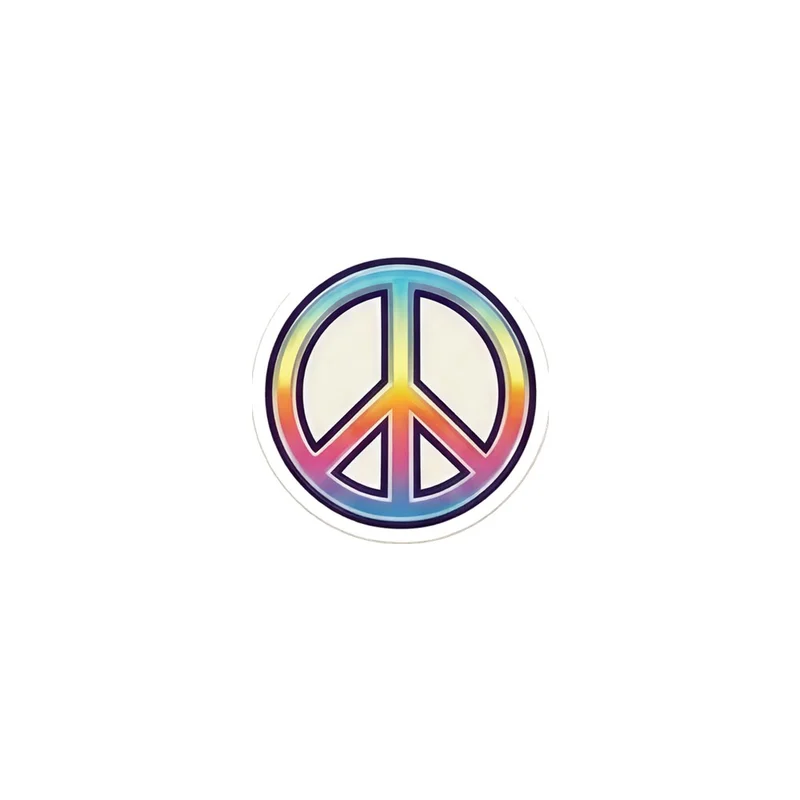
Rainbow Peace Sign Fridge Magnet, y2k icon, room decor, gift for y2k fans
A peace sign outlined in rainbow gradient on a pale disc. Die-cut and flexible, it sits flat on a fridge door or a locker.
The peace sign began as a political emblem rather than a general symbol of friendliness. British designer Gerald Holtom created it in 1958 for the Campaign for Nuclear Disarmament, ahead of a protest march from London to the Atomic Weapons Research Establishment at Aldermaston. Its shape combines the semaphore signals for N and D, standing for “nuclear disarmament”: a central vertical stroke with two angled lines descending from it, enclosed by a circle. The design was direct enough to read from a distance, and it soon moved beyond its original campaign. During the 1960s and 1970s, the sign appeared on banners, badges, posters and clothing connected with anti-war movements, civil rights protests and counterculture. Over time, its meaning widened. It can still call for disarmament, but it also suggests calm, solidarity, nonviolence and a familiar kind of hopeful resistance.
This artwork keeps that instantly readable structure while giving it a bright Y2K treatment. The peace sign is drawn as a clean outline whose colour shifts through a rainbow gradient, so the red, orange, yellow, green, blue and violet tones follow the curves instead of filling the centre with a solid block. Behind it, a pale circular disc creates a quiet field for the coloured line and softens the contrast against a white appliance, silver locker or painted metal surface. The circular format echoes the original sign while making the piece feel like a small graphic badge from a sticker-covered notebook or early-2000s bedroom. As a die-cut, flexible fridge magnet, it has the compact presence of a pin or decal without needing a frame. Place it among photographs, reminders, postcards or other magnets, or use the clean circle on its own where the rainbow edge can be seen clearly.
Someone who grew up with Y2K graphics may recognise the combination of cheerful colour, simple symbols and compact pop design immediately. It also suits people who collect peace signs, rainbow motifs, protest iconography or nostalgic room accessories, whether their reference point is a music video, a school folder, a mall display or an old internet avatar. The message is easy to read without being formal: peace, openness and a little visual optimism. On a fridge, it can mark a kitchen as lived-in and personal; on a locker, it adds colour to an otherwise plain metal door. It works as a small gift for a friend who likes early-2000s style, rainbow details or familiar cultural symbols, and it can sit comfortably beside more playful Y2K objects without taking over the surface. The design is recognisable at a glance, while the gradient gives it enough colour to reward a closer look.
“A compact rainbow peace sign brings playful Y2K color to fridges, lockers, and other small personal spaces.”
- SubjectSingle die-cut cartoon peace sign with a rainbow outline on a pale disc.
- Palette & lightRainbow gradient edging adds vivid color against the transparent background.
- CompositionOne centered motif lies flat, keeping the design crisp and easy to place.
- Where it fitsA cheerful accent for dorm lockers, fridge doors, or a Y2K fan’s room.
| Suited to | dorm room |
| Material | Made from 0.5 mm flexible vinyl |
| Digital printing | |
| Care | Wipe clean with a dry cloth; keep the printed face free of scratches. |
| Shipping | Made to order — ships in 2–5 business days |