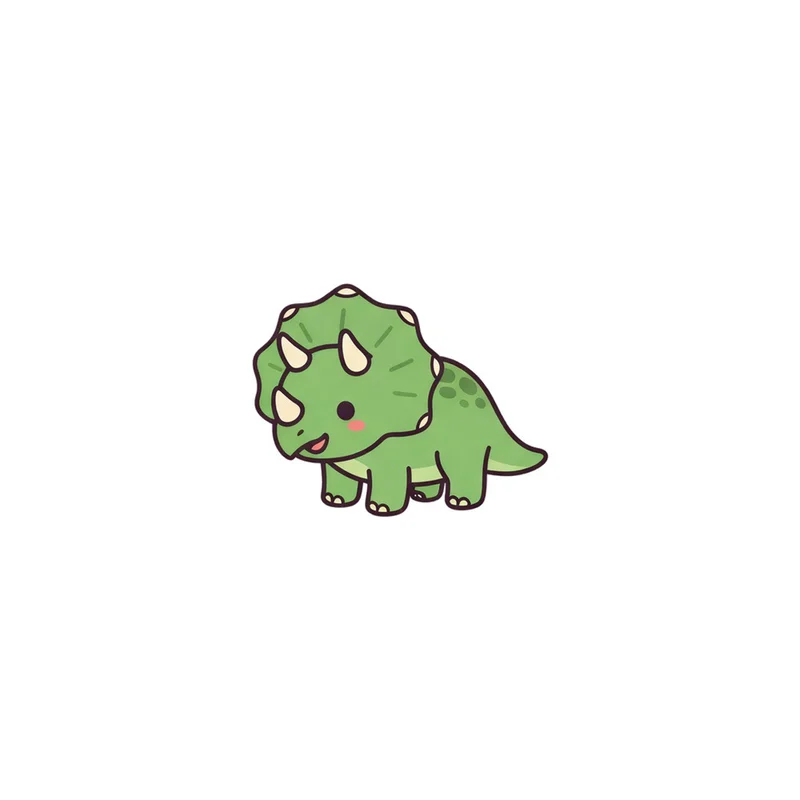
Little Triceratops Fridge Magnet, kawaii horned dinosaur, kids room decor, gift for dinosaur lovers
A stout green triceratops facing forward, three cream horns and a frill outlined in bold dark ink. Chunky and friendly on a fridge.
The eye meets a compact, front-facing dinosaur with a rounded body, a broad frill, and three cream-coloured horns arranged clearly above its face. The main palette is leafy green, warm cream, and deep charcoal or near-black for the outlines. Those dark lines are bold and even, giving the shape a hand-drawn quality while keeping each part easy to read at a glance: the curved frill, the short horns, the sturdy head, and the small feet tucked beneath its body. The proportions are intentionally chunky rather than naturalistic, with soft corners replacing sharp anatomical detail. Its forward-facing pose creates a direct, friendly presence, as though this small triceratops has paused to look straight back from the front of a fridge, a magnetic board, or a child’s playroom shelf. The limited colours also make it easy to place among everyday objects. Against a white fridge, the green body and dark outline stand apart cleanly; on a pale blue, butter-yellow, or light wood background, the cream horns add a warm accent without making the scene feel busy. It suits a room where picture books, wooden toys, dinosaur figures, and colourful drawings already share the space.
The style belongs to the kawaii tradition of Japanese character illustration and the wider late-20th-century popular design language built around approachable, simplified figures. One concrete marker is the use of rounded, reduced forms to turn a potentially formidable animal into a compact companion: the triceratops keeps its recognisable three horns and frill, but loses any threatening edge through its squat proportions, smooth curves, and calm front-facing stance. The heavy dark contour is another familiar character-design device, separating the figure from its background much as an inked outline does in stickers, stationery, cartoons, and children’s picture graphics. Rather than presenting a scientific reconstruction of a dinosaur, the artwork treats the animal as a named personality within a group of friendly characters. That makes it a natural fit for the Dino Pals series, where a child can recognise the creature quickly and imagine it as part of a small cast. The design has enough visual clarity for young children, while the restrained palette and confident linework also work for adults who prefer children’s decor with simple shapes instead of detailed scenes.
On a wall, this design wants a place with clear sightlines and gentle, even light: above a low bookcase in a child’s bedroom, beside a reading nook, or on a small gallery area near the kitchen. Since the piece is made to live on a magnetic surface, a white refrigerator door, metal filing cabinet, or magnetic noticeboard gives the green dinosaur a practical setting; on a wall nearby, it can sit among framed animal prints, alphabet art, or a row of small dinosaur pictures. Daylight from a nearby window will bring out the difference between the fresh green body, the pale cream horns, and the dark outline without changing the character of the image. Under warmer evening light, the cream details will take on a soft golden cast, pairing well with oak shelves, woven baskets, and beige or terracotta textiles. Keep a little space around it so the three horns and wide frill remain easy to see, especially when it is placed beside children’s drawings or colourful magnets.
“A friendly little triceratops brings playful dinosaur character to the fridge or a child’s room.”
- SubjectSingle stout green triceratops facing forward, with three cream horns and a bold outlined frill.
- Palette & lightFresh green, cream, and dark ink create a clear, cheerful cartoon palette.
- CompositionOne chunky die-cut character stands alone against a transparent background.
- Where it fitsA playful accent for a family kitchen, children’s room, or dinosaur lover’s fridge.
| Suited to | kids' room, kitchen and dining room |
| Material | Made from 0.5 mm flexible vinyl |
| Digital printing | |
| Care | Wipe clean with a dry cloth; keep the printed face free of scratches. |
| Shipping | Made to order — ships in 2–5 business days |