Fresh Vegetables & Spices Art Print, dark food photography, rustic kitchen wall art, dining room decor, gift for food lovers
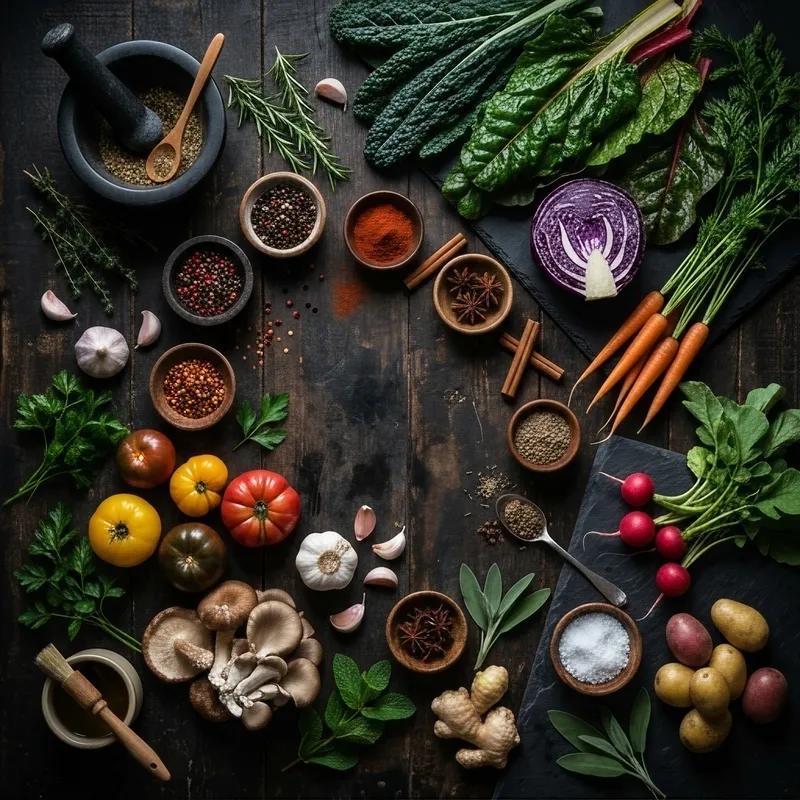
Fresh vegetables, herbs, and spices fill this dark, moody food photography flat lay, arranged on a rustic surface with dramatic chiaroscuro lighting. Printed on Enhanced Matte Paper (189 g/m²), the photorealistic detail brings rich texture and depth to a kitchen, dining area, or food lover’s home, and makes a thoughtful gift.
The eye meets a dense arrangement of ingredients set against a deep, nearly black rustic surface. Green leaves and stems create fine, branching lines around the broader shapes of vegetables, while small spices add scattered points of ochre, rust, red, and warm yellow. The palette moves between saturated greens, earthy browns, muted cream, and ember-like orange, with highlights picked out against heavy shadow. You can see the ridges of a pepper, the uneven skin of a root vegetable, the curled edge of a herb leaf, and the grain of the wooden surface beneath them. Nothing feels polished into geometric uniformity: the forms overlap, lean into one another, and leave narrow pockets of darkness between their edges. Strong light enters from one side, catching the textures nearest the front and allowing the background to recede. That contrast gives the arrangement a clear visual rhythm—bright ingredient, dark gap, layered shape—while the flat-lay viewpoint keeps every detail available to the viewer. The result has the focused line quality of a carefully composed photograph, with crisp contours where the light lands and softer transitions where color fades into shadow.
The image sits within the long still-life tradition of arranging ordinary food as a subject worthy of close attention. Its clearest period marker is chiaroscuro: a concentrated beam of light set against a dark field, used here to separate the vegetables, herbs, and spices from their surroundings. Rather than presenting a bright market scene or a spotless modern countertop, the composition favors the intimate atmosphere of a working kitchen. The rustic base, natural irregularities, and accumulation of ingredients suggest preparation before a meal, with each item retaining its own surface, color, and shape. This approach makes the familiar feel tactile and considered. It also connects the print to the visual language of traditional still life without placing it in a particular historical room or country. A viewer might read the clustered produce as a cook’s gathering on a wooden table, a collection of market finds, or the ingredients waiting beside a stove. The dark tonal range gives the scene a quiet, grounded character, while the flashes of green, red, and gold keep it connected to freshness and flavor.
Give it a wall where its deeper tones can settle into the room: above a wooden kitchen table, beside open shelving, over a sideboard in the dining area, or on a narrow wall near the pantry. It works naturally with aged timber, terracotta, dark green paint, charcoal, cream, brushed metal, and woven linen. In a bright white kitchen, the image can introduce warmth and visual weight; in a darker room, it can continue an existing palette of walnut, black, olive, and copper. Place it where directional daylight or a warm pendant light can reveal the layered shadows without washing out the darker background. It can anchor a small dining nook, add texture to a cooking space, or bring a food-focused detail to a hallway leading toward the kitchen. The realistic surfaces reward close viewing, so it suits a wall seen from both the table and the room’s entrance. For a food lover, home cook, host, or anyone drawn to market colors and rustic ingredients, the print offers a composed reminder of the raw materials behind everyday meals.
“A chiaroscuro flat lay that turns everyday produce into a study in texture and shadow, lending kitchens a quiet, painterly gravitas.”
- SubjectFresh vegetables, herbs, and spices arranged in a rustic flat lay
- Palette & lightDeep, moody tones with dramatic chiaroscuro highlights on matte paper
- CompositionOverhead flat lay with tight clustering and generous negative space
- Where it fitsKitchen, dining nook, or pantry wall of a serious home cook
| Style | Photographic |
| Subject | Fresh vegetables herbs spices |
| Colors | black, charcoal |
| Orientation | Square |
| Suited to | kitchen and dining room |
| Material | Enhanced Matte Paper (189 g/m²) |
| Digital printing | |
| Care | Frame or mount out of direct sunlight; wipe gently with a dry, soft cloth. |
| Shipping | Made to order — ships in 2–5 business days |