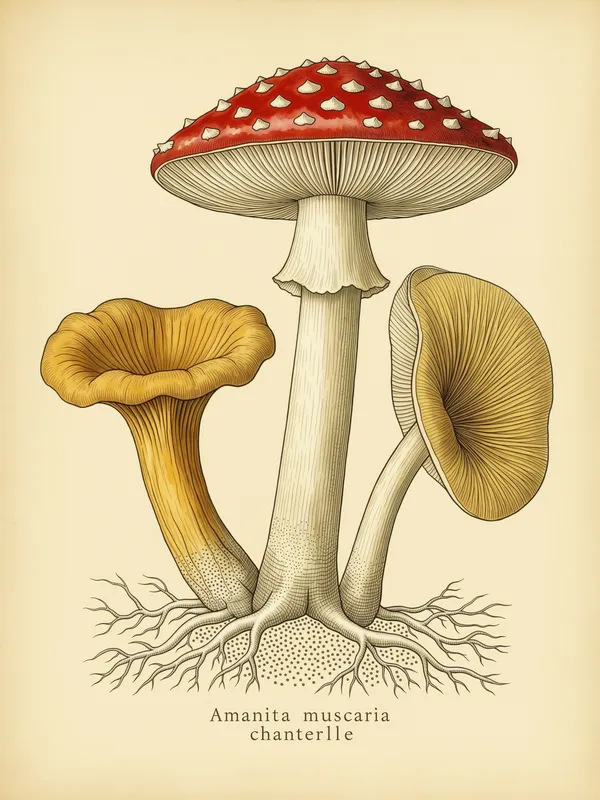
Wild Amanita Mushrooms Art Print, Victorian botanical illustration, vintage natural history decor, nature lover gift
Wild Amanita mushrooms appear as a Victorian natural history plate, rendered in fine pen-and-ink lines with delicate watercolor washes on a warm aged cream parchment ground. Latin species labels, spores, roots, and structural details create a precise scientific specimen aesthetic in this art print on Enhanced Matte Paper (189 g/m²), suited to a study, gallery wall, or thoughtful gift for a nature lover.
The eye meets a small gathering of wild Amanita mushrooms arranged like a carefully observed specimen study. Rounded caps rise above slender stems in varied shapes, with one form opening broadly while another keeps a tighter, bell-like profile. Rust red, muted scarlet, ochre, and soft cream colour the caps, with pale highlights suggesting their uneven surfaces and scattered flecks. The stems move through quiet shades of ivory, sand, and grey-green, while fine black and sepia lines describe gills, seams, roots, and the delicate structures beneath the soil. Small spore studies and Latin annotations sit around the main forms, giving the composition the measured balance of a page removed from a naturalist’s field book. Against the warm aged-cream ground, the ink remains crisp and the transparent washes retain a light, hand-painted character rather than becoming flat blocks of colour.
Its visual language belongs to the Victorian natural-history tradition, when plants and fungi were presented as subjects for both close study and careful display. A concrete marker of that period is the combination of formal Latin naming with enlarged structural details: the mushrooms are not simply pictured from above, but accompanied by the parts a collector or observer would want to examine. The neat lettering, ruled placement, and isolated specimens create the feeling of an illustrated reference plate, while the restrained palette keeps attention on shape and anatomy. Fine pen work gives the image a quiet precision, and the translucent watercolour adds the warmth associated with hand-coloured scientific illustrations. It sits comfortably within the Victorian Forest Botanicals series, alongside pressed leaves, woodland plants, and other pieces that bring the vocabulary of a botanical cabinet into a modern interior. For a study, reading room, or nature-focused gallery wall, it offers detail to discover at close range without losing its clear silhouette across the room.
Hang it where daylight can travel across the cream background and reveal the difference between ink, wash, and blank space. A north-facing wall, a window with filtered light, or a softly lit hallway will suit the subtle reds, ochres, and green-grey stems, allowing the image to remain calm rather than appear overly vivid. It can sit above a writing desk, beside bookshelves, near a collection of field guides, or in an entryway with other woodland imagery. A dark wood frame will deepen the sepia lines and echo the feeling of a Victorian cabinet, while natural oak or a narrow black frame will keep the presentation lighter and more contemporary. Place it with fern studies, pressed-flower motifs, landscape sketches, or other mushroom illustrations for a layered forest arrangement. On its own, the plate reads as an intimate study of form: a thoughtful choice for someone drawn to fungi, botanical drawing, old scientific books, and the quiet character of woodland walks.
“A Victorian-era natural history study that rewards close looking, pairing scientific precision with the quiet romance of antique botanical plates.”
- SubjectVictorian natural history illustration of wild Amanita mushrooms rendered in fine pen-and-ink with watercolor wash.
- Palette & lightWarm aged cream background with earthy watercolor washes in soft ochre, rust, and muted green tones.
- CompositionCentered specimen study with detailed anatomical features, delicate linework, and balanced negative space.
- Where it fitsA nature lover's study, a cottage-style hallway, or a mixed gallery wall of botanical prints.
| Style | Botanical illustration |
| Subject | Wild Amanita mushrooms |
| Colors | cream, beige |
| Orientation | Portrait |
| Suited to | gallery wall |
| Material | Enhanced Matte Paper (189 g/m²) |
| Digital printing | |
| Care | Frame or mount out of direct sunlight; wipe gently with a dry, soft cloth. |
| Shipping | Made to order — ships in 2–5 business days |