Porcini Mushroom Art Print, vintage botanical illustration, woodland wall decor, nature lover gift, antique field guide style
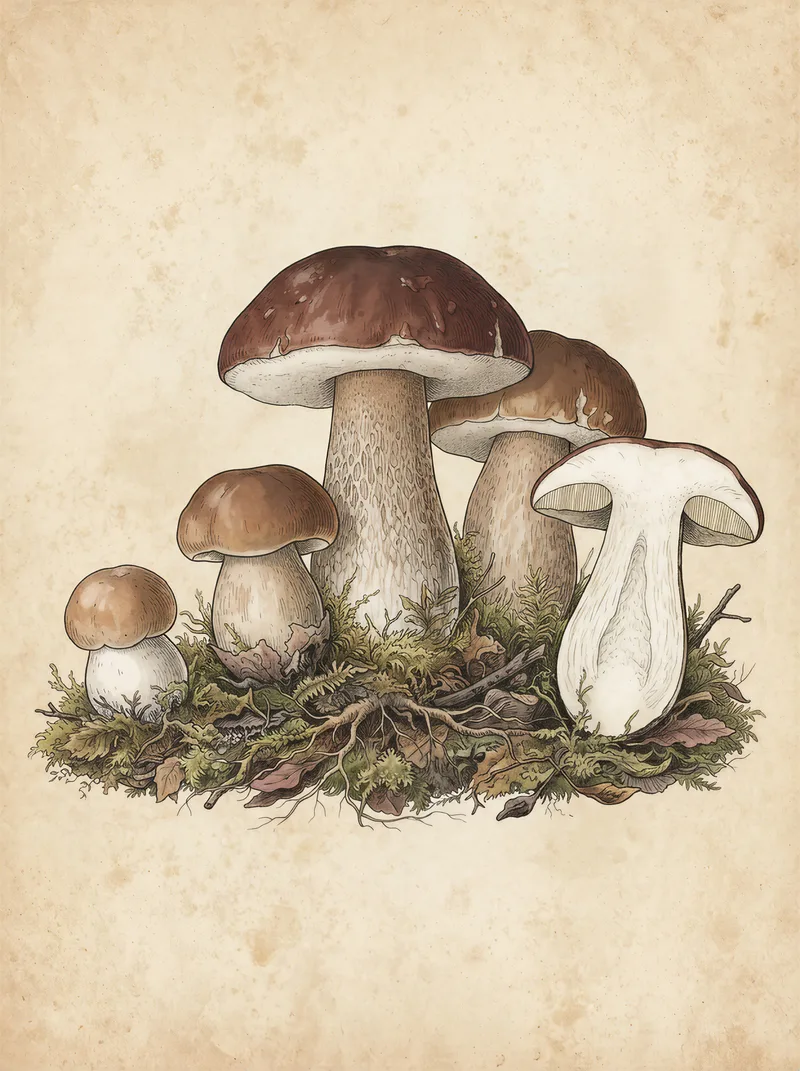
This Porcini mushroom art print shows several specimens at different growth stages, all rooted on one continuous mossy forest floor. Fine ink linework and soft gouache colour reveal gills and stipe in a sectioned specimen. Printed on Enhanced Matte Paper (189 g/m²), it brings an aged field guide palette to a woodland wall or makes a thoughtful gift for a nature lover.
The eye meets a quiet woodland study arranged across one continuous strip of mossy ground. Porcini appear at several stages of growth: small rounded forms sit near fuller caps, while a sectioned specimen opens the composition to show its pale gills and sturdy stipe. Fine ink lines define the edges, folds, and textures without making the scene feel rigid. Soft gouache washes bring in warm mushroom browns, muted cream, olive green, and cool grey, with the moss creating a low, earthy band beneath the forms. The restrained palette has the look of an aged natural-history plate, while the varied scale gives the arrangement a sense of close observation rather than a repeated pattern. Details reward a nearer look, from the cap contours to the delicate marks around the cut specimen, yet the overall image remains calm enough to read from across a room. Its continuous ground keeps the separate stages connected, making the print feel like one small clearing recorded at a single glance.
The style belongs to the tradition of vintage botanical and mycological field studies, where an illustrator combined precise observation with a limited hand-applied colour palette. One concrete marker is the pairing of fine black ink outlines with transparent-looking gouache areas: the line carries the structure, while the colour identifies the cap, gills, stem, and moss without covering every detail. The sectioned mushroom is another field-guide touch, presenting information as part of the image rather than treating the subject only as decoration. This gives the artwork a plate-like character, suited to shelves of natural-history books, pressed leaves, specimen boxes, and other objects gathered from the outdoors. It sits comfortably within the visual language of antique reference illustrations, but the woodland floor keeps it connected to a living setting. For a nature lover, mycology enthusiast, gardener, or anyone drawn to quiet forest details, the image offers both an identifiable subject and the pleasure of studying its shapes.
Hang it where natural textures and subdued colours already have a place: above a writing desk, beside a bookcase, in a hallway with timber furniture, or on a bedroom wall near linen, woven baskets, and green plants. The earthy brown, moss green, cream, and grey palette works with walnut, oak, black metal, and warm white surroundings. In morning or afternoon daylight, the ink contours and pale gouache washes remain easy to read, while angled light can bring out the changes between the darker caps and the lighter cut section. Under a warm lamp, the ochre and brown tones become more pronounced and the scene takes on the feel of a small woodland record. Leave enough surrounding space for the continuous mossy base to act as a visual resting line; placing it among several similarly sized nature studies can create a considered gallery arrangement, while a single placement lets the different mushroom forms remain the focus. It suits a quiet corner as readily as a more practical kitchen, study, or entryway.
“A field-guide style mushroom study that brings the quiet precision of botanical illustration into a kitchen or reading corner.”
- SubjectSeveral Porcini specimens at varied growth stages, one sectioned to reveal interior anatomy.
- Palette & lightMoody umber, moss green, ochre and dusty rose on aged warm paper with foxing.
- CompositionContinuous mossy forest floor base unites the specimens in a single tableau.
- Where it fitsA reading nook, kitchen corner, or the wall of a nature lover.
| Material | Enhanced Matte Paper (189 g/m²) |
| Digital printing | |
| Care | Frame or mount out of direct sunlight; wipe gently with a dry, soft cloth. |
| Shipping | Made to order — ships in 2–5 business days |