Twin Hemispheres Map Art Print, vintage world map, antique cartography, home office study decor, history enthusiast gift
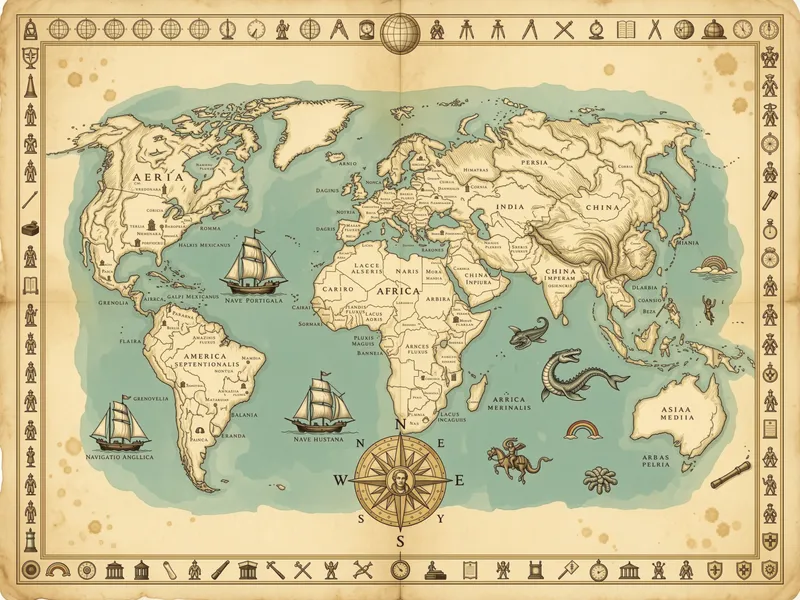
This art print presents an antique decorative map of the Celestial and Terrestrial Hemispheres, with finely engraved continents, an ornate compass rose, galleons, sea creatures, navigation instruments, and celestial globes. Printed on Enhanced Matte Paper (189 g/m²), its warm aged parchment, sepia, subtle teal, and copperplate details suit a study, office, or thoughtful gift for a map enthusiast.
The eye meets two broad circular hemispheres set against a warm parchment ground, their edges framed by fine copperplate lines and small engraved details. Landmasses are drawn in sepia and muted brown, while restrained touches of teal separate the surrounding seas and give the composition a measured contrast. An ornate compass rose anchors the maritime imagery, with sailing galleons, curling sea creatures, and navigation instruments filling the spaces around the mapped forms. Celestial globes and additional diagrammatic elements extend the subject beyond geography, creating a layered arrangement of routes, symbols, and observation. The linework is delicate rather than graphic, inviting a closer look at coastlines, lettering, arcs, and the repeated marks that make the map feel made for study. Its copper-toned engraving against aged cream, soft teal, and brown creates a quiet palette that sits comfortably alongside wood, leather, brass, and other materials commonly found in a study or reading room.
The artwork belongs to the antique decorative cartographic tradition, where a map was also a visual record of navigation, astronomy, and the world as understood through measurement and exploration. Its defining character comes from the way practical information is arranged with ornamental imagery rather than kept separate: the mapped hemispheres share the surface with a compass rose, ships, sea life, globes, and instruments. One concrete marker of this tradition is the engraved construction itself, with fine parallel strokes and closely spaced lines used to suggest coastlines, water, shading, and relief. The result recalls the appearance of a historical atlas plate or an old study document, while remaining balanced enough to function as wall art. For a home office, library, classroom, or history-focused room, it introduces a sense of geographic curiosity without relying on bright colour or modern graphic blocks. It also suits someone who enjoys maps for both their information and their visual language: circles, meridians, compass points, and carefully placed labels become part of the room’s atmosphere.
Give it a wall where the composition can be viewed from across the room and then approached for its smaller details. Above a writing desk, it can sit among notebooks, shelves, and framed documents; in a study or library, it pairs naturally with dark wood, painted cabinetry, aged metal, and neutral textiles. A soft daylight position will bring out the distinction between the parchment-coloured ground, sepia landforms, teal water, and copperplate marks without flattening the fine engraving. It also works under warm evening light, especially beside a desk lamp or shaded wall light, where the map’s restrained colours can blend with books and timber. Avoid placing it where strong glare or busy surrounding patterns compete with the circular forms. Hung on its own, it reads as a considered focal point; grouped with navigation, astronomy, or travel-themed pieces, it helps create a small collection centred on place, observation, and the long visual tradition of mapping the world.
“An antique-style twin hemispheres map invites quiet study, its compass roses and decorative borders rewarding close attention.”
- SubjectEastern and Western hemispheres paired within an antique cartographic frame, compass roses anchoring each side.
- Palette & lightWarm sepia and cream tones with faded ink details, evoking aged parchment under soft gallery lighting.
- CompositionTwo mirrored hemispheres sit side by side, framed by ornate cartouches and decorative borders of stars.
- Where it fitsA reader's study, curious home office, or any wall craving quiet wanderlust and old-world charm.
| Style | Vintage |
| Subject | Celestial and terrestrial hemispheres |
| Colors | beige, sage, tan |
| Orientation | Landscape |
| Suited to | reading nook, office |
| Material | Enhanced Matte Paper (189 g/m²) |
| Digital printing | |
| Care | Frame or mount out of direct sunlight; wipe gently with a dry, soft cloth. |
| Shipping | Made to order — ships in 2–5 business days |