Foxglove Apothecary Art Print, Victorian botanical illustration, study decor, antique curiosity cabinet style, gift for nature lovers
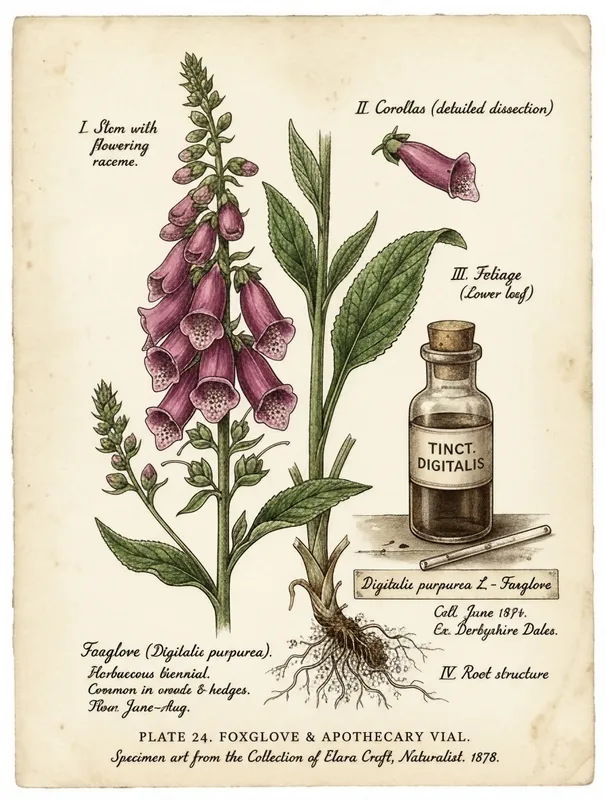
Foxglove stems stand beside an apothecary glass vial in this Victorian naturalist specimen study, rendered with fine ink linework, handwritten labels, and a sepia and deep green palette on aged cream paper. Printed on Enhanced Matte Paper (189 g/m²), the art print brings scholarly antique charm to a study, reading nook, or thoughtful gift for a botanical art enthusiast.
The eye meets a pair of tall foxglove stems rising along the left side of the composition, their bell-shaped flowers arranged like a measured botanical study rather than a loose garden scene. Beside them sits a small apothecary vial, its rounded glass body and narrow neck giving the image a clear vertical counterpoint. Fine ink lines define the stems, leaf veins, petals, and bottle contours, while restrained handwritten notes and labels occupy the open spaces around the specimens. The palette stays close to sepia, deep green, muted brown, and aged cream, creating the appearance of an old naturalist’s page without losing the clarity of each form. Small variations in line weight give the foxglove flowers a delicate edge and make the glass read as a separate, carefully observed object. The balance of plants, bottle, annotations, and breathing room suits a wall where the details can be seen at close range.
The style belongs to the Victorian tradition of botanical and natural history illustration, when plants were recorded through close observation and arranged as specimens for study. Its concrete marker is the combination of precise pen outlines with handwritten identification notes: the image is both a picture of foxglove and a page from an imagined working collection. The apothecary vial extends that sense of inquiry, connecting the flowering stems with the tools and containers associated with herbs, remedies, and old curiosity cabinets. Rather than presenting the plant as a broad landscape, the composition isolates its parts against a light ground, allowing the silhouette of each leaf and flower to remain legible. Sepia ink and deep green colour reinforce the period character, while the cream background gives the labels and linework room to sit clearly. It can speak to an interest in botany, natural history, vintage science, or the quiet visual order of a study lined with books and collected objects.
Hang it above a writing desk, alongside a bookcase, or on the wall of a reading nook where its narrow stems can echo the vertical lines of shelves and furniture. A warm, indirect lamp brings out the brown ink, cream ground, and muted green leaves, making the print feel at home beside oak, walnut, brass, leather, or dark-painted wood. It also suits a lighter room with white, parchment, or soft grey walls, where the sepia tones provide definition without introducing a bright accent colour. Place it near a small cabinet, ceramic vessel, framed map, or collection of botanical books to develop an antique curiosity-cabinet arrangement, or let it stand alone where the handwritten labels and vial can be appreciated without visual competition. As a gift, it fits a nature lover, gardener, herbalist, student, or anyone who enjoys the look of old specimen studies and scholarly interiors.
“Botanical study of foxglove bells on aged parchment lends quiet, scholarly charm to contemplative corners.”
- SubjectDusky pink foxglove bells and slender stems arranged as an apothecary specimen study
- Palette & lightSoft pinks and muted greens over warm aged parchment, printed on refined matte paper
- CompositionLoose vertical arrangement of blooms and stems, generous negative space, gently classical proportions
- Where it fitsA reading nook, study, or library wall where botanical detail rewards slow looking
| Style | Botanical illustration |
| Subject | Foxglove stems and apothecary vial |
| Colors | cream, white, beige |
| Orientation | Portrait |
| Suited to | reading nook |
| Material | Enhanced Matte Paper (189 g/m²) |
| Digital printing | |
| Care | Frame or mount out of direct sunlight; wipe gently with a dry, soft cloth. |
| Shipping | Made to order — ships in 2–5 business days |